GEK / GSEK · unscreened to 11 kV · screened with ground to 36 kV
End sealing kits, caps and covers for extensible RMU and GIS bushings
Three covers fit the same type C interface, and the choice turns on whether the bushing stays energised, whether the end is ever reopened, and how far up the voltage range it has to go.
End sealing kit for extensible RMU and GIS bushings (GEK / GSEK)
A heat-shrink cover that closes an unmade extensible bushing against moisture ingress. The datasheet's own headings set the ceiling by cover type: unscreened up to 11 kV, screened with ground up to 36 kV, on type C interfaces to EN 50180 and EN 50181.
- Seals and insulates the bushing end against moisture ingress
- Stated as compatible with all bushing types; the cap is removed when a new connection is made
- Compact design, for GIS bushing ends as well as RMU ways
- 100% factory tested
- Four published sizes, selected on bushing diameter rather than on voltage
| Voltage classes | Unscreened to 11 kV; screened with ground to 36 kV (datasheet headings) |
|---|---|
| Bushing interface | Type C, EN 50180 and EN 50181 |
| Code series | GEK-401, GEK-501 unscreened; GSEK-401, GSEK-501 screened |
| Recovered bore, Df | 35 mm (−401 codes) or 45 mm (−501 codes) |
| Shrink temperature | 125 °C [IEC 216] |
| Continuous temperature limit | −40 to +100 °C [IEC 216] |
| Dielectric strength | 12 kV/mm min. [ASTM D149] |
| Volume resistivity | 1 × 10¹⁴ Ohm·cm min. [ASTM D257] |
| Tracking and erosion | No failure to 3.25 kV for 20 min [ASTM D2303] |
| Production testing | 100% factory tested |
The decision, and the five inputs it needs
An extensible way that is not connected is still an open interface. The manufacturer's sheet is narrow about the failure it addresses, and the narrowness is useful: moisture ingress into the bushing end. No current-carrying or field-grading duty is claimed for the part anywhere in the source.
Five inputs settle which cover to raise a requisition for. The bushing standard and type — type C to EN 50180 and EN 50181 in this range. The voltage class, 11, 15 or 24 kV. Whether the bushing is energised behind the cover. Whether the accessible surface has to be touch-proof. And whether the way is spare-for-now or closed permanently.
Three separate products answer those inputs, and the published sheet lists all three under one heading. That is where a requisition goes wrong.
The three covers, in the manufacturer's own terms
End sealing kit. Seals and insulates the ends of extensible RMU and GIS bushings against moisture ingress, compatible with all bushing types, with the cap removed for a new connection. The unscreened form is headed on the datasheet as Un-screened Sealing Kit upto 11 kV. This is the cover for a spare way that is expected to be used later.
Touch-proof protective cap. Electrically insulates and mechanically seals the bushing interface, for permanent or temporary use. This is the cover for an interface that is not coming off again soon.
Screened end cap. A fully shielded, submersible insulating cover for an energised bushing once its drain wire is grounded, for permanent or temporary use on bushings, junctions or feed-through devices. Its datasheet heading reads Screened Sealing Kit with Ground upto 36 kV — so the screen is not only what makes the cover touch-proof, it is also what carries it above 11 kV.
The mapping is therefore published, and it runs on cover type rather than on code. The four codes are selected on bushing diameter: the −401 pair recovers to a 35 mm bore, the −501 pair to 45 mm. Voltage comes from whether the cover is screened, not from the suffix.
Why only the screened cap is touch-proof
Insulation lowers the touch voltage on an accessible surface. It does not take it to earth. The manufacturer's own separable-connector sheet defines the touch-proof property as an earthed outer conductive screen, and that definition is the one to apply here.
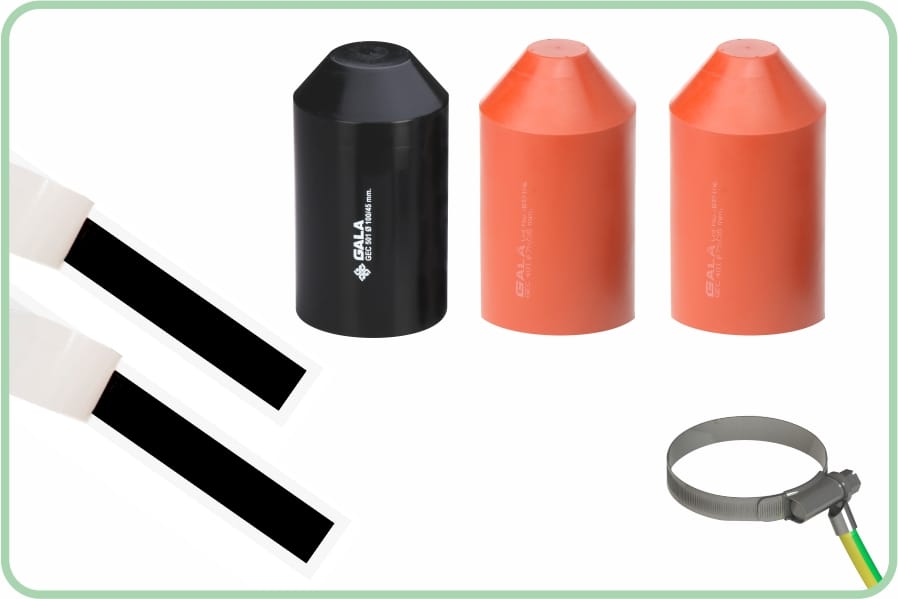
By that definition only the screened end cap qualifies, and it qualifies conditionally: the published wording rates it for an energised bushing once its drain wire is grounded. The earthing hardware is visible in the manufacturer's photograph, a worm-drive band with an earth lead. Fit the cap and leave that lead loose and the result is an insulated cover on a live bushing, not a touch-proof one.
The middle product carries touch-proof in its name while its published description says insulate and seal. Specify against the drain-wire connection, not against the product name.
What these covers are not
None of the three is a termination. Nothing here grades a field, carries a conductor or accepts a lug, so if a cable is being brought onto the bushing the part is a screened separable connector, not a cap. The covers exist for the ways you are not using.
They are also not boots. A bushing boot covers a connection already made; a cable terminal protector covers a lug in a compact entry box. Both sit over metal that is doing a job. A bushing end cap sits over metal that is doing nothing, and that is the distinction the store should pick on.
Selection chart — end sealing kits
| Gala code | Cover | Ds (min.) | Df (max.) | Ls (min.) | Tf (±10%) |
|---|---|---|---|---|---|
| GEK-401 | Unscreened | 75 | 35 | 125 | 4.0 |
| GEK-501 | Unscreened | 100 | 45 | 125 | 4.0 |
| GSEK-401 | Screened with ground | 71 | 35 | 125 | 4.0 |
| GSEK-501 | Screened with ground | 96 | 45 | 125 | 4.0 |
Ds is the internal diameter as supplied, Df the internal diameter after free recovery, Ls the length, Tf the thickness of the insulation layer after free recovery. All dimensions in mm. GEK is the unscreened kit, GSEK the screened kit with ground. The two charts are printed separately on the datasheet and are combined here because the −401 and −501 pairs cover the same bushing sizes.
Physical properties
| Property | Value | Standard |
|---|---|---|
| Alliance bushing | Type C | EN 50180 & EN 50181 |
| Tensile strength | 12 N/mm² (MPa) (min.) | ASTM D638 |
| Ultimate elongation | 350 % (min.) | ASTM D638 |
| Density | 1.05 ± 0.2 g/cm³ | ASTM D792 |
| Hardness | 45 ± 10 Shore D | ASTM D2240 |
| Water absorption | 0.2 % (max.) | ASTM D570 |
Reproduced from the manufacturer's technical specification for the end sealing kit.
Thermal properties
| Property | Value | Standard |
|---|---|---|
| Accelerated ageing | 120 °C for 500 h | ASTM D2671 |
| Tensile strength after ageing | 11 N/mm² (MPa) (min.) | ASTM D638 |
| Ultimate elongation after ageing | 300 % (min.) | ASTM D638 |
| Low-temperature flexibility, −40 °C for 4 h | No cracking | ASTM D2671 |
| Heat shock, 250 °C for 30 min | No cracking or flowing | ESI 09-11 |
| Shrink temperature | 125 °C | IEC 216 |
| Continuous temperature limit | −40 to +100 °C | IEC 216 |
Tensile and elongation figures in this table are the post-ageing values, not the as-supplied ones above.
Electrical properties
| Property | Value | Standard |
|---|---|---|
| Dielectric strength | 12 kV/mm (min.) | ASTM D149 |
| Volume resistivity | 1 × 10¹⁴ Ohm·cm (min.) | ASTM D257 |
| Dielectric constant | 5 (max.) | ASTM D150 |
| Resistance to tracking and erosion | No tracking, erosion or flame failure up to 3.25 kV for 20 min | ASTM D2303 |
The source qualifies this section: applicable for the insulation layer only. On the screened end cap the outer layer is conductive by design, so these figures do not describe its outside surface.
Fit and test, as published
Six statements the manufacturer makes about this range, and nothing beyond them.
- Mates C-type bushings and plugs complying with EN 50180 and EN 50181.
- Kit codes are the GEK and GSEK series, four published sizes; the datasheet heads the unscreened kit at 11 kV and the screened kit with ground at 36 kV, while the product page lists 11 kV, 15 kV and 24 kV.
- The range is published for GIS bushing ends as well as RMU extensible ways.
- Compact design; 100% factory tested.
- Shrink temperature 125 °C, with a continuous limit of −40 to +100 °C [IEC 216] — the cover sees ambient chamber temperature, not conductor temperature.
- Tracking and erosion resistance is stated to 3.25 kV for 20 min [ASTM D2303], which is a material class, not a withstand rating for the assembly.
The moulded GEC marking reads onto the same diameters
Caps photographed on the manufacturer's page carry a moulded GEC code with a two-figure diameter, in the form Ø 100/45 mm. GEC is the Insulcap heat-shrink cable end cap series, and its −401 and −501 codes carry the same bore pair as the sealing-kit codes: GEC-401 is Ds 75 / Df 35, GEC-501 is Ds 100 / Df 45, matching GEK-401 and GEK-501 exactly. A cap stamped GEC-501 Ø 100/45 is therefore the right diameter for a GEK-501 position. Order against the kit code and the bushing diameter all the same — the two series are catalogued separately and only the diameters are known to coincide.
Not published — ask the manufacturer
Three fields are genuinely absent. No AC, impulse or partial-discharge figure is published for any of the three covers — those exist in the source for the screened separable connector and belong to it alone. No pollution class is stated. And no published document names a kV figure against an individual code, only against the cover type, so a 24 kV bushing takes a screened kit chosen on its diameter rather than a code chosen on its voltage. Quote the bushing make, type and bore diameter and ask for the code against them. Withstand figures by class are set out on the type test chart.
Sources disagree — where the range stops
The datasheet caps the two covers by heading: unscreened upto 11 kV, screened with ground upto 36 kV. The manufacturer's product page for the same kit lists voltage classes 11 kV, 15 kV and 24 kV and stops there. Neither carries the other's numbers — 15 kV appears on the page and nowhere on the sheet, 36 kV appears on the sheet and nowhere on the page. Both are reproduced here as published. For anything above 24 kV, get the class confirmed against the code in writing before it goes on a requisition.
Sources disagree — submersible wording
The feature list on the manufacturer's page for this kit opens with provides a fully screened, submersible separable connection — wording carried across from the screened separable connector. The body text on the same page confines fully shielded and submersible to the screened end cap alone. Both are published, and both are reported here as published rather than averaged into one. For a chamber that takes water, name the screened end cap explicitly on the requisition rather than trusting the family feature list.
Getting the right cover quoted first time
Send the bushing make and type, the type C interface confirmation, the voltage class, the bore diameter, how many ways are being closed, and whether each way stays energised. That is enough to name one of the three products and its code without a second exchange.