Medium-voltage cable terminations
Cable terminations from 1.1 kV to 36 kV
Five inputs decide which kit goes on the requisition. The catalogued heat-shrink range runs 1.1 kV to 36 kV, and stops there.
- Cable insulation — XLPE, EPR, PVC or paper-insulated lead-covered
- Core count — 1, 2, 3, 3½ or 4
- Conductor cross-section in mm², from 16 mm² to 1000 mm² across the range
- Highest system voltage Umax — 1.1, 3.3, 12, 24 or 36 kV
- Indoor or outdoor, which is a different part number rather than the same kit fitted differently
The range stops at 36 kV
This domain is named after a product that is not catalogued. The manufacturer's heat-shrink termination kits end at 36 kV — GXO/E-3336 for extruded dielectric, GPO/E-3336 for paper. Three items in the published component list do carry a 66 kV rating — the red insulation tube for the joint area, the non-tracking tube and the stress control tube — but those are component ratings. A 66 kV-rated tube inside a 36 kV kit does not make a 66 kV termination, and nothing here is an offer of one. The full position.
AC dry withstand, by voltage class
The cable decides the kit; the voltage only decides the numbers
Move from 12 kV to 36 kV and the same items reappear with bigger figures. Move from XLPE to paper and half the box changes.
Extruded dielectric — XLPE and EPR
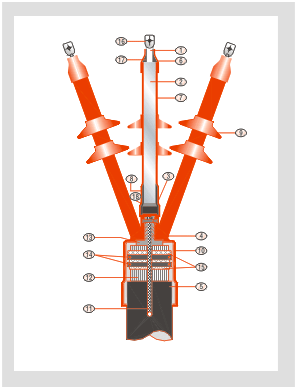
GXO/E-1112, -1524 and -3336 take 3-core shielded cable at 12, 24 and 36 kV; GXOS/E-1236 is the single-core equivalent to 36 kV. The insulation screen is cut back, so the box carries stress control tubing, stress control mastic, non-tracking weather-resistant tubing, a non-tracking breakout and tinned copper braid onto the metallic screen.
Paper-insulated lead-covered — PILC
GPO/E-1112, -1524 and -3336, covering 16 mm² to 500 mm² by class. Paper adds items extruded cable never needs: an oil barrier sleeve, a belting oil barrier sleeve, glass cushion tape, an earthing plumb bonding lead sheath to armour, and a conducting breakout. Belted cable has no per-core screen, so that breakout reconstructs one.
1.1 and 3.3 kV — either construction
GLT-1100 takes 1, 2, 3, 3½ and 4-core XLPE, PVC and paper cable, armoured or unarmoured, in one family. At these voltages there is no insulation screen to cut back, so the kit carries no stress control tube and no stress control mastic at all.
Termination, joint, gland — three different operations
A termination ends a cable at a bushing, a lug or an overhead line, and hands the electric field over to air. A joint connects two cable ends and rebuilds insulation, screening and mechanical protection through the splice. The manufacturer names the families separately: GLT, GXO/E, GXOS/E and GPO/E terminate; GXLT, GXS, GXSS, GPS and GTJ joint. The two put side by side.
A gland is the third thing, and it is mechanical. It anchors armour and seals the sheath at an enclosure wall; it does nothing about electrical stress. An armoured extruded kit does include an adhesive-lined gland sleeve, but as one item among a dozen. Short answers to the definitional questions.
Cutting the insulation screen back crowds the equipotential lines at the cut edge, and the tangential field along the insulation surface rises sharply. Two answers exist: lengthen the path geometrically with a stress cone, or redistribute the field with a high-permittivity material. The material answer is Insultube-Stress, a radiation cross-linked polymeric tube rated to 36 kV, operating from −40 °C to 100 °C, minimum shrink temperature 100 °C and fully shrunk at 130 °C. The mechanism, then the product.
Creepage is the other half, and it is settled in air rather than inside the cable. Rain sheds add shed rings so the surface path lengthens without the tail lengthening with it — published as no tracking, erosion or flame failure up to 3.25 kV for 20 minutes [ASTM D2303], dielectric strength 15 kV/mm minimum [ASTM D149], continuous operation −40 °C to +110 °C [IEC 216]. Shed count is published per class on the single-core GXOS/E series: outdoors 2 at 12 kV, 3 at 24 kV, 4 at 36 kV; indoors none at 12 kV, 1 at 24 kV, 2 at 36 kV. How a site's pollution severity maps onto that count is not published — ask the manufacturer.
One caution before those figures are quoted in a specification. AC and impulse withstand are consistent across the kit sheets; the DC withstand durations are not. The same 48 kV, 96 kV and 144 kV appear against 1 minute, 15 minutes and 30 minutes on different sheets. The type-test table reports both sides rather than averaging them away.
This is a reference, not a factory. Every kit, sleeve, shed, boot and connector described here is manufactured by Gala Thermo Shrink Pvt. Ltd. at Palghar, Maharashtra and at the Surat SEZ unit in Gujarat, with partial-discharge, high-voltage and general product testing done in-house. The manufacturer's termination index lists which series exist; the job here is choosing between them.
Five entry points
Every other page on this site is reached from one of these five.
- Heat-shrink termination kits, and how to specify oneSelection order: construction, cores, mm², Umax, indoor or outdoor
- Every component in an HT termination kit, namedWhat each item does, and which cable construction calls for it
- Screened separable connectors and the type C interface630 A to 24 kV and 630/1250 A to 36 kV, mating EN 50180 / EN 50181 bushings
- Ring main units, and the cable side of the bushingThe four ways that interface actually gets terminated
- Type-test withstand figures, class by classAC, DC and lightning impulse, with the durations printed as published
Send the inputs and the answer comes back as one kit code
Insulation, core count, mm², Umax, indoor or outdoor — plus armoured or unarmoured, and the bushing type where the cable lands in switchgear. An enquiry carrying those seven lines is answered once, not six times.