Kit family · GLT-1100
LV termination kits at 1.1 and 3.3 kV (GLT-1100)
Five inputs decide a GLT code: core count, conductor mm², armoured or unarmoured, extruded or paper, indoor or outdoor.
GLT-1100 termination kit
GLT-1100 spans both cable constructions in one family — extruded XLPE/PVC and paper-insulated — at 1.1 kV and 3.3 kV, armoured or unarmoured. No other termination family in the manufacturer's published range covers both, and none other ships without stress control.
- Ships without stress control tube, stress control mastic, oil barrier sleeve or rain shed
- Ten codes banded on cable size from 4x16–35 to 4x400–500 mm²
| Rated voltages | 1.1 kV and 3.3 kV |
|---|---|
| Cable constructions | Extruded (XLPE/PVC) and paper-insulated |
| Core counts | 1, 2, 3, 3½ and 4 |
| Armour | Armoured or unarmoured |
| Kit codes | GLT-01 to GLT-05 at 1.1 kV; GLT-11 to GLT-15 at 3.3 kV (catalogue) |
| Published size range | 4x16–35 to 4x400–500 mm² |
| Stress control supplied | None |
Electrical performance, as published for GLT-1100
| Test | Parameter for evaluation | Umax 1.1 kV | Umax 3.3 kV | Result |
|---|---|---|---|---|
| Insulation resistance | 1 min., 500 V DC | – | – | >10⁹ Ω |
| AC high voltage test (dry) | 15 min. | 4 kV | 8 kV | No breakdown, no flashover |
| Impulse withstand at ambient temperature | 10 positive and 10 negative | 8 kV | 12 kV | No breakdown, no flashover |
| Heating cycle test | 63 cycles, 8-hour cycle, 5 hrs heating and 3 hrs cooling | – | – | No breakdown, no flashover |
| Insulation resistance after impact test (immersed) | 1 min., 500 V DC | – | – | >10⁹ Ω |
| Impulse withstand at elevated temperature | 10 positive and 10 negative, conductor temperature 95 to 100 °C | 8 kV | 12 kV | No breakdown, no flashover |
| Heating cycle test | 63 cycles, 8-hour cycle, 5 hrs heating and 3 hrs cooling | – | – | No breakdown, no flashover |
| DC high voltage test (dry) | 5 min. | 15 kV | 21 kV | No breakdown, no flashover |
Reproduced from the manufacturer's GLT-1100 page, which heads its two voltage columns only as "test voltage — highest voltage Umax (kV)". The catalogue prints the same table under the heading Guaranteed Technical Particulars in compliance with IEC 60502, 60060 and 60230, and the GXLT/GPLT splicing kit labels the identical 8/12 kV impulse and 15/21 kV DC pairs explicitly at 1.1 kV and 3.3 kV. The heating cycle test is listed twice, once before and once after the elevated-temperature impulse.
Kit codes by cable size
| Cable size (sq mm) | GLT-0x column | GLT-1x column |
|---|---|---|
| 4x16–35 | GLT-01 | GLT-11 |
| 4x50–95 | GLT-02 | GLT-12 |
| 4x120–185 | GLT-03 | GLT-13 |
| 4x225–300 | GLT-04 | GLT-14 |
| 4x400–500 | GLT-05 | GLT-15 |
From the catalogue's ordering chart, which heads its two code columns Kit Code 1.1 kV and Kit Code 3.3 kV. The manufacturer's web page prints the identical table with the columns headed Outdoor and Indoor instead. Both are reproduced; see the note below.
Sources disagree — what the second code column means
The same five-row table is published twice with different column headings. The catalogue heads the two code columns Kit Code 1.1 kV and Kit Code 3.3 kV. The manufacturer's GLT-1100 page heads them Outdoor Kit Code and Indoor Kit Code. The cable-size bands are identical in both. This is not a detail: on one reading a GLT-13 is a 3.3 kV kit for 120–185 mm², on the other it is an indoor 1.1 kV kit for the same cable. The catalogue reading is the one that explains why no rain shed appears against either set — neither column is an outdoor kit. State the voltage and the mounting on the order and let the reply name the code.
What is in the box
Ten items are listed against GLT-1100. Every one is a sleeve, an earth path, or an installation aid.
- Heat-shrinkable terminal sleeve — over the lug and the cut core end.
- Heat-shrinkable insulation sleeve — over the core run below the lug.
- Heat-shrinkable cable breakout — the moulded crutch seal.
- Jubilee clamp — the worm-drive clip holding the braid down.
- Tinned copper earth braid — the armour-to-earth path.
- Black mastic sealing tape — cold-applied butyl sealant.
- Terminal lug, cleaning tissue, mopping cloth and installation instructions.
Why no stress control tube is supplied
Stress control tube has one published job in this range: controlling the electrical stress at insulation-screen terminals, on cable and joints up to 36 kV. At 1.1 kV and 3.3 kV the cable is built without an insulation screen, so there is no screen terminal to grade. IEC 60502-1 covers rated voltages of 1 kV and 3 kV; screened construction, and the field-grading problem that comes with it, belongs to IEC 60502-2 from 6 kV upward.
Every other termination family the manufacturer publishes lists a stress control tube or sleeve — GXO/E for extruded cable, GPO/E for PILC, GXOS/E for single-core. GLT-1100 lists neither the tube nor the stress control mastic, and that omission is the sharpest line between an LV kit and an MV one.
So an LV termination is a sealing and earthing job, not a field-grading one. What the kit prevents is water tracking into the crutch and an armour bond that was never tight, not surface discharge across a screen cut-back. No rain shed is listed against either mounting code either — see rain sheds for where creepage extension starts to matter, and stress control tube for the component this kit does without.
Sources disagree — core count against kit code
The GLT-1100 source describes 1, 2, 3, 3½ and 4-core cable. The same source writes its kit-code range only in four-core sizes: 4x16–35 up to 4x400–500 mm². Both statements are published and neither corrects the other. A single-core or 3½-core selection therefore cannot be read off the code range, and has to be confirmed against the specific cable before the requisition is raised.
The crutch seal comes from Insulcore-LV
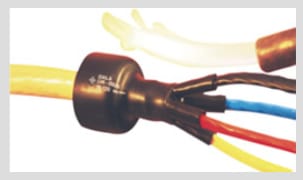
The breakout inside a GLT kit is the Insulcore-LV moulded crutch seal, and its own published scope is wider than the kit's: 2, 3, 4, 5, 6 or 7-core PVC, XLPE, rubber or PILC cable up to 3.3 kV.
Material is cross-linked polyolefin, internally lined with hot melt adhesive, giving IP68 water and moisture proofing once installed. Custom dimensions are made to order.
So a five, six or seven-core LV cable can be crutch-sealed from this range even though it falls outside the core counts GLT-1100 names. Figures below come from the Insulcore-LV breakout datasheet.
Insulcore-LV breakout: published material properties
| Property | Value | Method |
|---|---|---|
| Tensile strength | 12 N/mm² min. | ASTM D638 |
| Ultimate elongation | 350% min. | ASTM D638 |
| Density | 1.05 ± 0.2 g/cm³ | ASTM D792 |
| Hardness | 45 ± 10 Shore D | ASTM D2240 |
| Water absorption | 0.2% max. | ASTM D570 |
| Dielectric strength | 12 kV/mm min. | ASTM D149 |
| Volume resistivity | 1 × 10¹⁴ ohm.cm min. | ASTM D257 |
| Shrink temperature | 125 °C | – |
| Continuous temperature limit | −40 °C to +110 °C | IEC 216 |
| Heat shock — no cracking or flowing | 250 °C for 30 minutes | ESI 09-11 |
| Low temperature flexibility — no cracking | −40 °C for 4 hours | ASTM D2671 |
Technical Qualification Report No. QR 1012.
Armour continuity is what this termination is judged on
At 1.1 kV the insulation is the easy part. The armour bond is what gets inspected, because the armour is the cable's earth path and a poor bond stays invisible until an earth fault goes looking for it. Two of the ten kit items exist for that one connection: the tinned copper earth braid and the jubilee clamp holding it against the armour.
Nothing in the published contents replaces the cable gland. Where armour is clamped mechanically at the entry point, that hardware is specified separately from GLT-1100, and the kit's own clip secures the braid rather than taking mechanical load. Terminating into a panel or a compact cable box changes the enclosure work but not this bond — see switchgear and panel terminations.
On the paper-insulated variant, notice what is again absent. The 12 to 36 kV PILC kits carry an oil barrier sleeve, a belting oil barrier sleeve, glass cushion tape and an earthing plumb bonding lead sheath to armour. GLT-1100 carries none of those. Termination kits for PILC cable sets out what changes once the lead sheath has to be bonded.
Not published — ask the manufacturer
Two things a specification clause still needs are missing from the GLT-1100 source. One: a class designation — GXO/E, GPO/E and GXOS/E are all published as Class I and this family is not, so nothing says whether the omission is deliberate. Two: any separate outdoor build. No rain shed, no weather sleeve and no second tail length is listed against any GLT code, so if the tail is going outside, that is a question rather than a code. Two earlier entries on this list have been withdrawn: the size-to-code map is published in the catalogue's ordering chart above, and the type-test table is headed Guaranteed Technical Particulars in compliance with IEC 60502, 60060 and 60230 there — the web page simply drops that heading.
The construction ladder
What cable you have decides the component list. What voltage you have only decides the numbers in the table.
- Termination kits for XLPE and EPR cableGXO/E and GXOS/E, 12 to 36 kV
- Termination kits for PILC cableGPO/E, 12 to 36 kV
- Indoor or outdoor terminationWhat actually changes inside the box
- Every component in a termination kit, named
- Where the published range stopsThe 36 kV ceiling
- Sequence and tools for making the termination
GLT-1100 questions
Can GLT-1100 terminate paper-insulated cable?
What is the difference between GLT-01 and GLT-11?
What voltages is the kit type-tested at?
Is GLT-1100 the right kit for 6.6 kV or 11 kV cable?
Is a termination kit interchangeable with a joint kit at this voltage?
Send the cable make-up, not the kit code
A GLT selection needs five facts: core count, conductor mm², armoured or unarmoured, extruded or paper, indoor or outdoor. With those five in the first message, the reply can name a code instead of asking for them.