Termination kits for XLPE and EPR cable (GXO/E and GXOS/E)
Four facts settle the kit code: core count, conductor mm², Umax, and indoor or outdoor. Nothing else moves it.
The decision, and the four facts it needs
Core count picks the series. GXO/E terminates three-core cable; GXOS/E-1236 is the single-core equivalent, and it is a different component list rather than a thinner one.
Conductor cross-section picks the code inside the series — GXO-11 through GXO-15 at 12 kV, GXO-21 through GXO-24 at 24 kV, GXO-31 through GXO-34 at 36 kV.
Umax picks the voltage class. The 24 kV kit absorbs three cable ratings at once: 8.7/15 kV, 11/11 kV and 12.7/22 kV all sit under GXO/E-1524.
Indoor or outdoor picks the letter. GXO and GXOS are outdoor, GXE and GXES are indoor, and that letter changes tail length and shed count — never the stress control.
GXO/E and GXOS/E heat-shrink termination kits
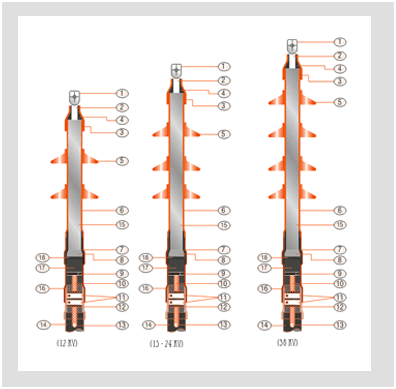
Heat-shrinkable termination kits for extruded-dielectric, shielded, armoured or unarmoured cable at 12 kV, 24 kV and 36 kV. Supplied as an itemised component set, not a moulded body.
- Adhesive-lined terminal sleeve and non-tracking weather-resistant tubing
- Stress control tubing over the screen cut-back
- Rain shed and non-tracking cable breakout
- Tinned copper earth braid and worm drive clips
- Temperature-sensitive paint on the GXO/E kits, changing colour when shrinking is complete
- GXOS/E adds stress control mastic, a constant force spring roll or solder tack, and an adhesive-lined gland sleeve for armoured cable
| Three-core series | GXO/E-1112 · GXO/E-1524 · GXO/E-3336 |
|---|---|
| Single-core series | GXOS/E-1236 |
| Cable | XLPE / EPR, shielded, armoured or unarmoured |
| Voltage classes | 12 kV · 24 kV · 36 kV (Umax) |
| Conductor range | 16 to 1000 mm² across the four families |
| Outdoor kit codes | GXO-11..15 · GXO-21..24 · GXO-31..34 · GXOS |
| Indoor kit codes | GXE-11..15 · GXE-21..24 · GXE-31..34 · GXES |
| Designation | Class I on GXO/E-1524, GXO/E-3336 and GXOS/E-1236 |
The four extruded-dielectric kits, by code
| Kit family | Cores | Outdoor code | Indoor code | Conductor range | Umax |
|---|---|---|---|---|---|
| GXO/E-1112 | 3 | GXO-11 to GXO-15 | GXE-11 to GXE-15 | 16 to 500 mm² | 12 kV |
| GXO/E-1524 | 3 | GXO-21 to GXO-24 | GXE-21 to GXE-24 | 16 to 400 mm² | 24 kV |
| GXO/E-3336 | 3 | GXO-31 to GXO-34 | GXE-31 to GXE-34 | 25 to 400 mm² | 36 kV |
| GXOS/E-1236 | 1 | GXOS | GXES | 16 to 1000 mm² | 12 to 36 kV |
Kit codes and conductor ranges as published by the manufacturer on each product page.
Tail lengths and rain sheds, as published
| Kit family | Class | Tail, outdoor | Tail, indoor | Sheds, outdoor | Sheds, indoor |
|---|---|---|---|---|---|
| GXO/E-1112 | 12 kV | 600 mm | 450 mm | 6 per kit, 2 per core | None |
| GXO/E-1524 | 24 kV | 800 mm | 550 mm | 9 per kit, 3 per core | 1 per core |
| GXO/E-3336 | 36 kV | 900 mm | 700 mm | 12 per kit, 4 per core | 2 per core |
| GXOS/E-1236 | 12 kV | 600 mm | 450 mm | 2 | None |
| GXOS/E-1236 | 15–24 kV | 800 mm | 550 mm | 3 | 1 |
| GXOS/E-1236 | 36 kV | 900 mm | 700 mm | 4 | 2 |
Taken from the catalogue's kit-component quantity columns and its accessories notes. Shed counts for the three-core kits are printed per kit, so the per-core figure is the kit total divided by three and is shown as both. Special tail lengths are made to order.
Withstand figures, by kit family
| Kit family | System voltage | AC dry withstand | DC withstand | Lightning impulse | Partial discharge |
|---|---|---|---|---|---|
| GXO/E-1112 | 12 kV | 35 kV, 1 minute | 48 kV, 30 minutes | 75 kV crest | Extinction above 12.7 kV, below 5 pC |
| GXO/E-1524 | 24 kV | 50 kV, 1 minute | 96 kV, 30 minutes | 125 kV crest | Extinction above 25.4 kV, below 5 pC |
| GXO/E-3336 | 36 kV | 75 kV, 1 minute | 144 kV, 30 minutes | Above 170 kV crest | Extinction above 38 kV, below 5 pC |
| GXOS/E-1236 | 12 kV | 35 kV, 1 minute | 48 kV, 1 minute | 75 kV | 12.7 kV |
| GXOS/E-1236 | 15–24 kV | 50 kV, 1 minute | 96 kV, 1 minute | 125 kV | 25 kV |
| GXOS/E-1236 | 36 kV | 75 kV, 1 minute | 144 kV, 1 minute | 170 kV | 38 kV |
| All four | 12 / 24 / 36 kV | 29 / 57 / 86 kV, 5 minutes | 38 / 76 / 114 kV, 15 minutes | 95 / 125 / 170 kV peak | ≤ 5 pC at 11 / 22 / 33 kV |
The three-core figures come from the catalogue's Electrical Specifications pages; the single-core figures from the GXOS/E-1236 product page. The manufacturer's three-core web pages carry no electrical table at all, which is a gap in those pages rather than in the product. The last row is the type-approval regime from the catalogue's guaranteed technical particulars, in compliance with IEC 60502-4 and CENELEC HD 629.1 — a different test to a different figure, set out on the type-test chart.
Not published — ask the manufacturer
Three things a type-test clause still needs are missing from the source. No type-test report number, laboratory or date is published against any of these kit codes — the electrical figures are stated as requirements met, not as a certificate. No short-circuit or thermal rating appears per kit; continuous current is given only as as per cable. And Class I is printed beside three of the four families with no definition anywhere: the standards behind the range are published, IEC 60502-4 and CENELEC HD 629.1, but nothing says what the class grades. Request the type-test report against the specific kit code before any of this reaches a schedule.
Sources disagree — the DC soak, and where the sheds are counted
Two conflicts sit under this table, and both matter at handover. The DC duration. The catalogue states 48, 96 and 144 kV for 30 minutes across the three-core kits; the manufacturer's GXOS/E-1236 web page states the same three voltages for 1 minute; and the guaranteed technical particulars run 38, 76 and 114 kV for 15 minutes instead. A 30-minute DC soak and a 1-minute one are not the same test. The three-core web pages. GXO/E-1524 and GXO/E-3336 as published on the website carry the 12 kV kit's tail lengths, shed note and heading text verbatim, and the 3336 page's own description still names the 1524 series. The catalogue does not, and its ladder is monotonic. Where they differ, this page follows the catalogue and says so. Neither figure is averaged.
What extruded dielectric forces into the kit
The metallic screen is cut back and the cut edge is left exposed. Every item below exists because of that edge, or because of the crutch below it.
- Stress control tubing over the screen cut-back. Insultube-Stress is radiation cross-linked, rated to 36 kV, and works from −40°C to 100°C.
- Stress control mastic against the cut edge, filling the step the screen leaves. It is itemised on GXOS/E-1236; the GXO/E pages list tubing only.
- Non-tracking weather-resistant tubing over each core, standing in for the oil barrier sleeve that a paper cable needs and an extruded one does not.
- Non-tracking cable breakout at the crutch. Insulcore-NT shows no tracking, erosion or flame failure to 3.25 kV for 20 minutes [ASTM D2303], dielectric strength 12 kV/mm minimum [ASTM D149].
- Tinned copper braid to the metallic screen, held by worm drive clips. GXOS/E adds a constant force spring roll, or a solder tack.
- Adhesive-lined gland sleeve on armoured single-core cable, with the braid supplied fitted with a terminal lug and a solder block.
- No oil barrier sleeve, no belting oil barrier, no earthing plumb. Those three are paper-cable parts and they are not in these kits.
Single-core is not a three-core kit with two cores left out
GXOS/E-1236 covers 16 to 1000 mm². That is more than double the 400 mm² ceiling of the 36 kV three-core kit, and it is the widest conductor range anywhere in the extruded series.
It carries more creepage rather than less. Outdoors it is supplied with 2 sheds at 12 kV, 3 at 15–24 kV and 4 at 36 kV — which is exactly the per-core count the three-core kits get, since GXO/E-1112 ships 6 sheds for three cores, GXO/E-1524 ships 9 and GXO/E-3336 ships 12.
Indoors the two ranges match as well: nothing at 12 kV, one shed per core at 15–24 kV, two at 36 kV. The pattern is a property of the class, not of the core count.
Tails match too — 600, 800 and 900 mm outdoor and 450, 550 and 700 mm indoor at 12, 24 and 36 kV, on both ranges. What actually separates single-core is the conductor span and the component list, not the weather hardware.
GXO/E against GXOS/E, line by line
| GXO/E (three-core) | GXOS/E-1236 (single-core) | |
|---|---|---|
| Conductor range | 16–500 mm² at 12 kV; 16–400 at 24 kV; 25–400 at 36 kV | 16–1000 mm² at every class |
| Kit families | Three separate kits: 1112, 1524, 3336 | One family spanning 12 kV to 36 kV |
| Outdoor tail | 600 / 800 / 900 mm at 12 / 24 / 36 kV | 600 / 800 / 900 mm at 12 / 24 / 36 kV |
| Indoor sheds | 0 / 1 / 2 per core at 12 / 24 / 36 kV | 0 / 1 / 2 at 12 / 15–24 / 36 kV |
| Screen earthing | Tinned copper braid and worm drive clips | Braid with lug and solder block, plus spring roll or solder tack |
| Armour sealing | Not itemised on the manufacturer's pages | Adhesive-lined gland sleeve |
| Shrink indication | Temperature-sensitive paint changes colour when complete | Not stated |
| Published withstand | 12 kV class only | All three classes |
Reading the paint, and what an under-shrunk stress tube costs
Insultube-Stress begins to shrink at 100°C and is fully shrunk at 130°C. Between those two figures the tube has visibly moved and has not recovered.
A tube in that state sits proud of the screen edge instead of conforming to it, which leaves the one air gap on a termination that nothing downstream can compensate for.
That 30°C window is what the temperature-sensitive paint on the GXO/E kits is for. It distinguishes shrunk from softened, which the eye on a torch-lit pole top cannot.
No paint changeover temperature is published, and no colour is named. Treat the paint as a go / no-go indication, not as a measurement.
The decision the kit does not make for you
GXOS/E supplies the braid, the clip, the lug and the solder block. It does not decide what the metallic screen is connected to at each end of the circuit.
Single-core runs are where that matters, because a voltage is induced along the screen of every single-core cable carrying load current. Bonding both ends, bonding one end, or cross-bonding are all served by the same kit code.
So the screen bonding arrangement is settled by the circuit design before a requisition is raised, and nothing on the manufacturer's page states one. That is correct: a termination kit is not where the decision lives.
Available on request and not part of the standard kit: solderless earthing kits, special-purpose earthing kits, polymeric insulators and T brackets. Special tail lengths are made to order.
The rest of the construction ladder
Cable construction changes the component list. Voltage only changes the numbers in the tables above.
- Termination kits for PILC cable (GPO/E series)Oil barrier sleeves, belting oil barrier, earthing plumb and a conducting breakout — the parts this page does not need.
- LV termination kits at 1.1 and 3.3 kV (GLT-1100)The one family covering extruded and paper cable together, and the only one with no stress control at all.
- Indoor or outdoor: what actually changes in the kitThe GXO / GXE letter, worked through in full.
- 66 kV: what Gala does and does not makeGXO/E-3336 at 36 kV is the ceiling. No 66 kV cable termination kit is catalogued.
Questions this page gets asked
Does GXO/E suit EPR as well as XLPE?
Which kit takes an 11 kV cable?
Is an indoor kit just the outdoor kit without sheds?
What is the largest conductor covered?
Can these kits be used on a paper cable?
Is there a 66 kV version of GXO/E?
Send the cable make-up, not the kit code
A GXO/E or GXOS/E enquiry is answered first time when it carries core count, conductor mm², the U0/U marking, armoured or unarmoured, indoor or outdoor, and the tail length wanted.