Kit components
The four sleeves inside an HT termination, and the job each does
Work out which of the four you are actually short of. That decision needs cable insulation, core count, conductor mm² and Umax before it needs a part code.
Scope of this page
Four sleeves ship inside a heat-shrink termination kit, and those four are the whole subject here. Tubing bought as a material — priced per metre, cut on site, chosen from a supplied-and-recovered diameter chart — is a different purchase entirely; anti-tracking tube by the metre is covered on shrink-tube.com, a sister reference published by the same people as this site and drawing on the same manufacturer's data. If the requisition line carries a length rather than a kit code, that is where to go.
Why four parts and not one thick tube
Each of the four is compounded for one job and is poor at the other three. Insultube-Stress is a radiation cross-linked polymeric material that controls the high electrical stress present at an insulation-screen terminal; it is not the insulation. The non-tracking sleeve carries the surface withstand once the core is out in air. The adhesive-lined terminal sleeve is a sealant carrier over the lug barrel. The oil barrier sleeve is a diffusion barrier, and it exists only because paper cable has an impregnant to stop.
Which four arrive in the box follows from cable construction, not from the number on the drawing. A GXO/E kit for XLPE or EPR and a GPO/E kit for PILC at the same Umax hold different sleeve sets, because only one of the two has oil to block and a lead sheath to bond.
Kit codes are the fastest way to confirm what a given box should contain. GXO-21 to GXO-24 outdoor and GXE-21 to GXE-24 indoor cover 16 to 400 sq mm at 24 kV. GPO-31 to GPO-34 outdoor and GPE-31 to GPE-34 indoor cover 35 to 400 sq mm at 33 and 36 kV. GXOS and GXES cover single-core cable from 16 to 1000 sq mm, up to 36 kV.
The four sleeves
- Adhesive-lined terminal sleeve
- Closes the top of the termination where the lug barrel meets the core. GXOS/E-1236 and every GPO/E kit publish it as a heat shrinkable adhesive-lined terminal sleeve; GXO/E and GLT-1100 list a terminal sleeve without stating the lining. Lug sealing mastic goes under it on the PILC kits, never instead of it.
- Non-tracking weather-resistant sleeve
- Holds the surface withstand along the exposed core in pollution, salt and rain. This is the part specified when a schedule asks for an 11 kV or a 33 kV insulation sleeve, and it is why an outdoor termination is not simply a longer piece of tube. GXOS/E-1236 names it an anti-tracking sleeve; GXO/E and GPO/E name it non-tracking weather-resistant tubing. It does not extend creepage on its own — rain sheds do that, fitted over it.
- Stress control sleeve
- Redistributes the field where the earthed insulation screen is cut back and the equipotential lines crowd together. Insultube-Stress is the discrete component; the manufacturer's component list also names a GVOT integrated stress control sleeve used as an integral part of terminations up to 24 kV, and GXOS/E-1236 ships stress control mastic beside the sleeve. Mechanism and the faults that defeat it: stress control tube.
- Oil barrier sleeve and belting oil barrier sleeve
- Stops impregnant migrating out of paper insulation and up the core. Both appear in the GPO/E kits only — one at each core, one at the belt — alongside glass cushion tape and the earthing plumb that bonds lead sheath to armour. No XLPE, EPR or LV kit in the range carries either. Component list: termination kits for PILC cable.
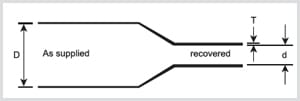
The stress control sleeve, supplied and recovered
Which sleeve ships in which kit
| Sleeve | GLT-1100 (LV, 1.1/3.3 kV) | GXO/E (3-core XLPE/EPR) | GXOS/E-1236 (single core) | GPO/E (3-core PILC) |
|---|---|---|---|---|
| Adhesive-lined terminal sleeve | Terminal sleeve, 4 Nos.; lining not stated | Terminal sleeve, 3 Nos.; lining not stated | Yes, adhesive-lined, 1 No. | Yes, adhesive-lined, 3 Nos. |
| Non-tracking weather-resistant sleeve | No — plain insulation sleeve only | Yes | Yes, listed as anti-tracking sleeve | Yes |
| Stress control sleeve | No | Yes | Yes, plus stress control mastic | Yes |
| Oil barrier sleeve | No | No | No | Yes |
| Belting oil barrier sleeve | No | No | No | Yes, on 1112, 1524 and 3336 |
Compiled from the manufacturer's published component lists for GLT-1100, GXO/E-1524, GXO/E-3336, GXOS/E-1236, GPO/E-1112, GPO/E-1524 and GPO/E-3336. "No" means the item is absent from the published list, not that it is prohibited.
Sources disagree — 36 kV or 66 kV on the same sleeve
The manufacturer's component list, Components for Cable Joints & Terminations, states that red insulation tube insulates the joint area up to 66 kV and that non-tracking tube and stress control tube are also rated to 66 kV. The product page for that same stress control tube, Insultube-Stress, states 36 kV. Both figures are published, neither is withdrawn, and they are reported here as they stand rather than averaged. Note also what a component rating is not: a sleeve rated at 66 kV does not make a 66 kV termination kit, and the catalogued kits end at 36 kV. See the 36 kV limit.
Insultube Non-Tracking (GAT) selection chart
| Code | D (min.) mm | d (max.) mm | T (±10%) mm | Spool length (m) |
|---|---|---|---|---|
| GAT 25/8 | 25 | 8 | 2.5 | 30 |
| GAT 35/12 | 35 | 12 | 2.7 | 30 |
| GAT 45/16 | 45 | 16 | 3.0 | 30 |
| GAT 55/20 | 55 | 20 | 3.0 | 30 |
| GAT 65/25 | 65 | 25 | 3.0 | 15 |
| GAT 75/28 | 75 | 28 | 3.0 | 15 |
| GAT 100/38 | 100 | 38 | 3.0 | 15 |
The non-tracking weather-resistant sleeve, bought loose. D is the internal diameter as supplied, d the internal diameter after free recovery, T the recovered wall. Published to 36 kV against technical qualification report QR 1021. Heavy-wall GAT(HW) sizes run the same bores at a 5 mm wall, in lengths to 1.5 m.
Insultube-Stress (GST) selection chart
| Code | D (min.) mm | d (max.) mm | T (±10%) mm |
|---|---|---|---|
| GST30/12 | 30 | 12 | 2.3 |
| GST40/18 | 40 | 18 | 2.4 |
| GST50/20 | 50 | 20 | 2.4 |
| GST60/25 | 60 | 25 | 2.4 |
The stress control sleeve, on the same D / d / T convention. Four sizes only, against seven on the non-tracking tube — which is the first sign that the two are compounded for different jobs rather than cut from one stock.
The two compounds, side by side
| Property | Non-tracking (GAT) | Stress control (GST) | Standard |
|---|---|---|---|
| Dielectric constant | 5 (max.) | 15 (min.) | ASTM D150 |
| Volume resistivity | 1 × 10¹⁴ Ohm·cm (min.) | 1 × 10⁷ Ohm·cm (min.) | ASTM D257 |
| Dielectric strength | 15 kV/mm (min.) on the datasheet, 12 kV/mm on the page | Not published | ASTM D149 |
| Tensile strength | 10 N/mm² (min.) | 12 MPa (N/mm²) (min.) | ASTM D638 |
| Ultimate elongation | 350 % (min.) | 300 % (min.) | ASTM D638 |
| Hardness | 45 ± 10 Shore D | 45 ± Shore D | ASTM D2240 |
| Shrink temperature | 125 °C | 125 °C | IEC 216 |
| Continuous temperature limit | −40 to +100 °C on the datasheet, +110 °C on the page | −40 °C to +100 °C | IEC 216 |
| Tracking and erosion | No failure to 3.25 kV for 20 min | Not published | ASTM D2303 |
One row does all the work. A non-tracking sleeve is an insulator; a stress control sleeve is deliberately not one. Dielectric constant 15 against 5, and volume resistivity seven decades apart, is the whole difference between covering a field and redistributing it.
What ships alongside, and is not a sleeve
Several items in the box are tape. None substitutes for a sleeve, and two of them do not appear in a termination kit at all.
- Mastic sealing tape — a cold-applied butyl sealant. Published as an installation aid with cleaning solvent on GPO/E-1112, and as black mastic sealing tape on GLT-1100.
- Lug sealing mastic, written as lug sealing tape/mastic on GPO/E-3336. It sits under the terminal sleeve at the barrel and is consumed by it, not an alternative to it.
- Glass cushion tape — in all three GPO/E kits, listed beside the belting oil barrier sleeve.
- Copper woven flexible mesh tape — published in the joint kits GPS/1112, GPS/2436 and GXS/1236, and in none of the termination kits. Red insulating mastic tape appears once in the whole range, in the GXSS-1236 single-core joint kit. Terminations use tinned copper earth braid with worm drive clips for the screen and armour instead.
A sleeve bought loose is not a termination
Sliding a length of non-tracking tube over a core and shrinking it down leaves four things undone. Each is a separate item in the kit.
- No stress control at the cut-back. The field concentrates at the point the earthed screen ends; a non-tracking sleeve laid over it changes nothing about that.
- No creepage extension. Sheds are supplied against system voltage — GXOS/E-1236 publishes 2 at 12 kV, 3 at 24 kV and 4 at 36 kV outdoors — and a loose sleeve brings none of them.
- No screen or armour earth. Tinned copper earth braid, worm drive clips, and on PILC the earthing plumb from lead sheath to armour, are in the box precisely for that path.
- No seal at the lug. The adhesive-lined terminal sleeve with lug sealing mastic closes the barrel; leaving it open leaves the one aperture the seal exists to shut.
Not published — ask the manufacturer
Two things a specifier reasonably asks about these sleeves are absent from the published material. Which sleeve size ships against a given kit code — the GAT and GST charts above band the tubes on core diameter, but nothing published maps a kit code onto a chart row, so a GXO-23 box cannot be checked against them on receipt. And the length supplied per core, which is what decides whether a deep cable box can be reached at all. Two earlier entries are withdrawn: the diameter tables are published, both of them, and the permittivity is published — dielectric constant 15 minimum for the stress control compound, 5 maximum for the non-tracking one. Put cable make-up, core count, mm², Umax and indoor or outdoor in the message and ask through contact.
Where each sleeve is actually decided
- Every component in an HT termination kit, namedThe whole box list, sleeves in their place
- Grading the field at the screen cut-backThe cut-back, and what defeats the sleeve on site
- Rain shedsCreepage added over the non-tracking sleeve
- Termination kits for XLPE and EPR cableGXO/E and GXOS/E sleeve sets, by kit code
- Termination kits for PILC cableThe only kits carrying both oil barrier sleeves
- Indoor or outdoor terminationWhat changes in the sleeve set, and what does not
Naming the sleeve you are short of
Quote the kit code printed on the box — GXO-23, GPE-32, GXOS — together with cable insulation, core count, mm² and Umax. That is enough to identify a single sleeve without anyone attending site.