Kit hub · 1.1 kV to 36 kV
How to specify a heat-shrink termination kit
Five inputs settle a kit code: insulation type, cores, mm², Umax, indoor or outdoor.
The decision this page resolves
A kit code cannot be derived from a voltage on its own. Five facts about the cable settle it, and they have to be taken in one particular order.
Insulation type goes first, because it decides the series, and the series decides which components are in the carton at all. A paper-cable kit carries an oil barrier sleeve, a belting oil barrier sleeve, glass cushion tape and an earthing plumb bonding the lead sheath to the armour. An extruded-dielectric kit carries none of those four items. It carries a non-tracking breakout, a tinned copper earth braid and worm drive clips instead.
Begin at the voltage instead and the mistake stays invisible until the crate is opened on site. A 24 kV requirement returns GXO/E-1524 and GPO/E-1524 with equal confidence, and only one of them fits the cable in the trench.
The five inputs, in order, and what each one selects
- 1 · Insulation type
- Extruded XLPE or EPR routes to GXO/E and GXOS/E. Paper insulated lead covered routes to GPO/E. At 1.1 and 3.3 kV, GLT-1100 accepts XLPE/PVC and paper cable in the same family.
- 2 · Core count
- Single-core extruded cable is a different series, not a variant: GXOS/E-1236. Three-core extruded is GXO/E. GLT-1100 covers 1, 2, 3, 3½ and 4-core constructions.
- 3 · Conductor cross-section
- This picks the individual code within the series. GXO/E-1524 spreads 16 to 400 mm² across four codes, GXO-21 to GXO-24 outdoors.
- 4 · Umax
- Read the highest system voltage, not the cable's U0/U marking. GXO/E-1524 covers 8.7/15 kV, 11/11 kV and 12.7/22 kV cable under one Umax = 24 kV kit.
- 5 · Indoor or outdoor
- A separate part number, not a fitting choice. It changes the tail length and the shed count as well as the code letter.
Series map by construction, with conductor ranges and code pairs
| Series | Cable construction | Cores | Umax | Conductor range | Outdoor codes | Indoor codes |
|---|---|---|---|---|---|---|
| GLT-1100 | XLPE/PVC or paper insulated, armoured or unarmoured | 1, 2, 3, 3½, 4 | 1.1 and 3.3 kV | 4x16–35 to 4x400–500 mm² | GLT-01 to GLT-05 | GLT-11 to GLT-15 |
| GXO/E-1112 | XLPE/EPR, shielded | 3 | 12 kV | 16 to 500 mm² | GXO-11 to GXO-15 | GXE-11 to GXE-15 |
| GXO/E-1524 | XLPE/EPR, shielded, armoured or unarmoured | 3 | 24 kV | 16 to 400 mm² | GXO-21 to GXO-24 | GXE-21 to GXE-24 |
| GXO/E-3336 | XLPE/EPR, shielded, armoured or unarmoured | 3 | 36 kV | 25 to 400 mm² | GXO-31 to GXO-34 | GXE-31 to GXE-34 |
| GXOS/E-1236 | Extruded dielectric, shielded, armoured or unarmoured | 1 | 12 to 36 kV | 16 to 1000 mm² | GXOS | GXES |
| GPO/E-1112 | PILC, armoured or screened | 3 | 12 kV | 16 to 500 mm² | GPO-11 to GPO-15 | GPE-11 to GPE-15 |
| GPO/E-1524 | PILC, screened, lead sheathed or armoured | 3 | 24 kV | 25 to 500 mm² | GPO-21 to GPO-24 | GPE-21 to GPE-24 |
| GPO/E-3336 | PILC, screened, lead sheathed or armoured | 3 | 33 and 36 kV | 35 to 400 mm² | GPO-31 to GPO-34 | GPE-31 to GPE-34 |
Umax figures, conductor ranges and kit codes as published on the manufacturer's individual kit sheets. GXOS/E-1236 covers 12, 24 and 36 kV within one series rather than splitting into three.
Not published — ask the manufacturer
"Class I" is printed on the GPO/E-1112, GPO/E-1524, GPO/E-3336, GXO/E-1524, GXO/E-3336 and GXOS/E-1236 sheets. It is absent from the GXO/E-1112 and GLT-1100 sheets, which are otherwise written to the same pattern. The standards behind the range are published — the catalogue's guaranteed technical particulars are headed in compliance with IEC 60502-4 and CENELEC HD 629.1 — but no document says what the class grades or what Class II would change. Before that phrase goes into a schedule clause, ask what it grades — and quote the withstand figures and the two standards in the meantime: the type-test chart.
Indoor and outdoor are two part numbers, not one kit fitted twice
Same cable, same Umax, two codes. What changes between them is published series by series, and the shed count is only part of it.
| What changes | Outdoor kit | Indoor kit |
|---|---|---|
| Three-core extruded code range | GXO-11 to GXO-34 | GXE-11 to GXE-34 |
| Three-core PILC code range | GPO-11 to GPO-34 | GPE-11 to GPE-34 |
| Single-core extruded prefix | GXOS | GXES |
| 1.1 and 3.3 kV code range | GLT-01 to GLT-05 | GLT-11 to GLT-15 |
| Tail length, GXO/E at 12, 24 and 36 kV | 600 mm | 450 mm |
| Tail length, GPO/E-1112 and GPO/E-3336 | 600 mm | 450 mm |
| Tail length, GPO/E-1524 | 800 mm | 550 mm |
| Tail length, GXOS/E-1236 | 900 / 800 / 600 mm at 36 / 24 / 12 kV | 700 / 550 / 450 mm at 36 / 24 / 12 kV |
| Rain sheds, GXOS/E-1236 | 2 at 12 kV, 3 at 24 kV, 4 at 36 kV | None at 12 kV, 1 at 15–24 kV, 2 at 36 kV |
| Rain sheds, GXO/E and GPO/E-1112 and -3336 | Included | None supplied |
Sources disagree — indoor sheds at 24 kV
Three kit sheets from the same manufacturer do not agree on whether an indoor 24 kV termination carries sheds. GXO/E-1524 states that indoor kits are supplied without rain sheds. GPO/E-1524 states that indoor terminations carry one rain shed per core. GXOS/E-1236 states one indoor shed from 15 to 24 kV. All three readings are reported here as published, and no average is taken between them. Confirm the shed count against the acknowledged kit code rather than against the series, and see rain sheds for what the shed is doing in the first place.
Three kit pages, split by what is in the carton
Choose by the cable in the trench. Voltage only changes the figures in the table; construction changes the item list.
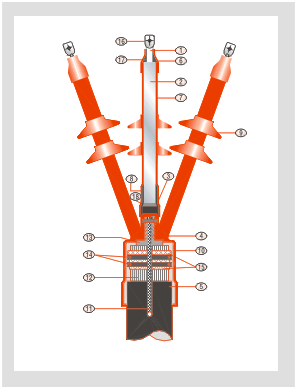
Extruded: XLPE and EPR
Three-core GXO/E-1112, -1524 and -3336, plus single-core GXOS/E-1236 reaching 1000 mm². Stress control tubing, a non-tracking breakout and a copper earth braid over the screen.
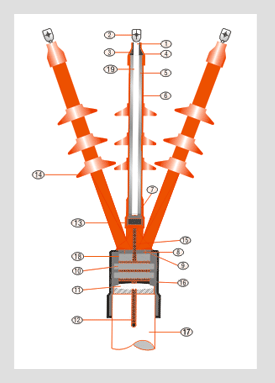
Paper: PILC
GPO/E-1112, -1524 and -3336. Oil barrier sleeve, belting oil barrier sleeve, glass cushion tape, a conducting breakout and an earthing plumb from lead sheath to armour.
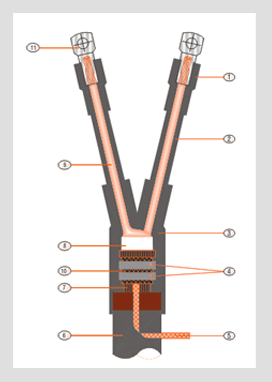
1.1 and 3.3 kV, either construction
The one family that takes XLPE/PVC and paper cable together, armoured or unarmoured, 1 to 4 cores. Terminal sleeve, insulation sleeve, breakout, jubilee clamp — and no stress control component at all.
What the carton does not bring to site
The published component lists are itemised, so their gaps are as informative as their contents. Nothing below is an omission to complain about; it is scope that belongs to the installer or to a separate order line.
- No heat source. Gas torch, regulator and hose are not itemised on any of the eight kit sheets.
- No crimping tool or die set, although the lug it compresses is itemised on GLT-1100 and on the GPO/E series.
- No terminal lug on the extruded kits. GXO/E and GXOS/E component lists do not name one; GLT-1100 and GPO/E do.
- Earthing hardware beyond the braid. Solderless and special-purpose earthing kits, polymeric insulators and T brackets are listed as available on request against the GXO/E series, which places them outside standard contents.
- Worm drive clips are optional on GPO/E-1524, and itemised as standard on GXO/E and GXOS/E.
- Consumables stop at cleaning and sealing. Mastic sealing tape and cleaning solvent ship with GPO/E-1112; cleaning tissue, mopping cloth and installation instructions ship with GLT-1100.
- No cable gland. GXOS/E-1236 includes an adhesive-lined gland sleeve for armoured cable, which seals the armour break and is not a gland.
Questions that come up while the requisition is open
Does one code cover both 33 kV and 36 kV?
Where does the published range stop?
How does the jointer know the shrink is finished?
Why is single-core a different series rather than a size?
Is a termination kit interchangeable with a joint kit?
Can a kit be specified from the cable size alone?
Send the cable schedule line, not the voltage
Insulation type, cores, mm², Umax and indoor or outdoor is enough to return a kit code first time. The manufacturer's own index of the GLT, GXO and GPO series is at galathermo.com.