Kit contents
Every component in an HT termination kit, named
Seventeen named parts, the job each one does, and which cable construction puts it in the box.
Settle five inputs before reading any component list
The component list is an output, not a starting point. Five inputs fix it: cable make-up (extruded dielectric, or paper-insulated lead-covered), core count, conductor size in mm², highest system voltage Umax, and whether the cable end lands indoors or outdoors. Those five select the kit series, and the series determines which parts arrive.
A heat-shrink termination is an itemised set supplied complete for one cable end, not a single moulded component. The published range runs from GLT-1100 at 1.1 kV and 3.3 kV to GXO/E-3336 and GPO/E-3336 at 36 kV, and stops there — read the 36 kV ceiling before writing a clause above that class. Names below are reproduced as the manufacturer publishes them.
Parts that carry the electrical duty
- Adhesive-lined terminal sleeve
- Shrinks over the lug barrel and the cut end of the core insulation, sealing that step with its internal adhesive. Named adhesive-lined on GPO/E and GXOS/E; the GXO/E and GLT pages list it simply as the terminal sleeve.
- Stress control tube
- Radiation cross-linked polymeric material that grades the field where the insulation screen is cut back, published to 36 kV as Insultube-Stress. Operating range −40°C to 100°C, minimum shrink temperature 100°C, fully shrunk at 130°C, standard colour black. Detail and the integrated GVOT variant.
- Stress control mastic
- Cold-applied filler taken over the screen cut-back step so no air void sits at the highest-field point of the termination. Listed on the GXOS/E single-core kits beside the stress control sleeve, not in place of it.
- Non-tracking weather-resistant sleeve
- The outermost layer over each core, and the one that survives surface discharge rather than bulk field. Called the anti-tracking sleeve on GXOS/E. The four sleeves compared.
- Oil barrier sleeve
- PILC kits only. Stops impregnating compound migrating up the core from the paper insulation into the termination, where it would soften the adhesive interfaces above it.
- Belting oil barrier sleeve
- PILC kits only, and a separate item from the per-core oil barrier: it seals the belt region below the crutch. Listed on GPO/E-1524 and GPO/E-3336 together with glass cushion tape.
- Cable breakout
- Seals the crutch — the point at which a multi-core cable's cores separate. Three breakouts exist and they are not interchangeable; selection is set out below.
- Rain shed
- Adds surface creepage as a series of shed rings without lengthening the tail. Published as Insulshed, chart GRS 130-1 to GRS 130-6, dielectric strength 15 kV/mm min [ASTM D149], no tracking, erosion or flame failure up to 3.25 kV for 20 minutes [ASTM D2303]. How many per core.
- Temperature-sensitive paint
- A marking rather than a part. The GXO/E pages state it changes colour when shrinking is complete, and it is the only shrink-completion indicator published for these kits.
Parts that earth it, clamp it and seal the mechanics
- Terminal lug and lug sealing mastic
- The lug is listed inside GLT-1100 and GPO/E. The mastic — lug sealing tape/mastic on GPO/E-3336 — is a PILC-series item sealing the palm-to-barrel transition before the terminal sleeve goes on.
- Tinned copper earth braid
- The main earthing path from screen or armour to the earth bar. On GXOS/E it arrives already fitted with a terminal lug and a solder block.
- Earthing plumb
- PILC kits only. A plumbed metal connection tying the lead sheath to the armour so the two metallic layers cannot sit at different potentials. Listed on GPO/E-1524 and GPO/E-3336.
- Constant force spring roll, or solder tack
- Fixes the earth braid onto the screen. Published as an either/or on GXOS/E, and the alternative matters wherever solder is prohibited on site.
- Worm drive clips and jubilee clamps
- Mechanical clamping at the gland and armour. GXO/E, GXOS/E and GPO/E list worm drive clips, optional on the GPO/E kits above 12 kV; GLT-1100 lists a jubilee clamp.
- Glass cushion tape
- A PILC-series item across GPO/E-1112, GPO/E-1524 and GPO/E-3336, building and cushioning the profile under the sleeving over lead and armour edges.
- Adhesive-lined gland sleeve
- Listed on GXOS/E for armoured single-core cable, sealing the armour-to-outer-sheath transition at the gland.
- Mastic sealing tape
- Cold-applied butyl sealant in strip form, named on GLT-1100 as black mastic sealing tape and carried in the standard aid pack below.
The three breakouts, and what selects between them
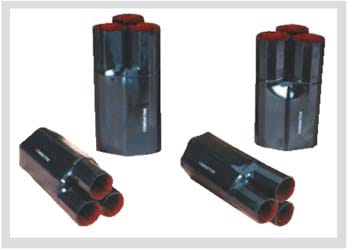
This is the component most often ordered wrongly, because all three look alike in a photograph. The deciding question is not voltage — it is whether the cable carries a screen on each core.
Insulcore-LV — LV2GBB to LV7GBB
2 to 7-core PVC, XLPE, rubber or PILC cable up to 3.3 kV. Cross-linked polyolefin, hot-melt adhesive lined, IP68 once installed. Dielectric strength 12 kV/mm min [ASTM D149], tensile 12 N/mm² min and elongation 350% min [ASTM D638], density 1.05±0.2 g/cm³ [ASTM D792], hardness 45±10 Shore D [ASTM D2240]. Technical Qualification Report No. QR 1012.
Insulcore-NT — GAB-0820 to GAB-3060
3-core PVC or PILC cable up to 36 kV. Non-tracking cross-linked polyolefin, water-resistant mastic lined, density 1.15±0.2 g/cm³ [ASTM D792], no tracking, erosion or flame failure up to 3.25 kV for 20 minutes [ASTM D2303]. This is the breakout named in the GXO/E kits.
Insulcore semi-conductive — GCB-0820 to GCB-2755
PILC belted cable, where cores sit inside a common belt with no screen of their own. It seals the crutch and rebuilds that missing screen per core: cross-linked semi-conductive polyolefin, red mastic lining, IP68, volume resistivity 1 x 10⁷ ohm.cm min [ASTM D257]. GPO/E calls it the conducting breakout.
A breakout is sized from diameters, not from mm²
Selection charts are written in diameters in two states: as supplied, and after free recovery. The body as supplied must clear the cable over belt or bedding; the legs after free recovery must close onto the individual cores. A schedule quoting only conductor mm² cannot pick a breakout — over-sheath and core diameters have to come off the cable maker's drawing. Body and leg wall thicknesses are quoted separately, at ±10 per cent, because the leg recovers much further and draws thinner.
Insulcore-NT selection chart, GAB-0820 to GAB-3060
| Code | Cores | D s min. | D f max. | d s min. | d f max. | L s min. | L f max. | l s min. | l f min. | Tb +10% | Tc +10% |
|---|---|---|---|---|---|---|---|---|---|---|---|
| GAB-0820 | 3 | 60 | 20 | 25 | 8 | 160 | 188 | 45 | 62 | 3.7 | 2.8 |
| GAB-0820 A | 3 | 70 | 20 | 27 | 8 | 155 | 188 | 40 | 62 | 3.7 | 2.8 |
| GAB-1330 | 3 | 80 | 30 | 39 | 13 | 185 | 215 | 60 | 75 | 3.9 | 3.1 |
| GAB-1330 A | 3 | 100 | 30 | 39 | 13 | 185 | 215 | 60 | 75 | 3.9 | 3.1 |
| GAB 2145 | 3 | 110 | 45 | 55 | 20 | 200 | 230 | 70 | 90 | 4.3 | 3.0 |
| GAB-2145 A | 3 | 125 | 45 | 55 | 21 | 190 | 230 | 65 | 90 | 4.3 | 3.0 |
| GAB-2755 | 3 | 140 | 56 | 68 | 28 | 215 | 250 | 80 | 90 | 4.0 | 3.0 |
| GAB-2755 A | 3 | 180 | 56 | 70 | 29 | 210 | 255 | 80 | 90 | 4.0 | 3.0 |
| GAB-3060 | 3 | 200 | 60 | 70 | 30 | 190 | 225 | 70 | 85 | 4.0 | 3.0 |
D and d are internal diameters; s = as supplied, f = after free recovery; Tb and Tc are the thickness of body and core. Dimensions in mm. Reproduced from the manufacturer's anti-tracking breakout datasheet.
Which construction brings which component
Quantities in brackets are the catalogue's own Qty. column, for a three-core kit unless stated. A cell reading "Not listed" means the component does not appear anywhere in that family's published contents.
| Component | GLT-1100 · 1.1/3.3 kV | GXO/E · 3-core XLPE/EPR | GXOS/E · single-core | GPO/E · 3-core PILC |
|---|---|---|---|---|
| Terminal lug | Listed (4 Nos.) | Listed (3 Nos.) | Listed (1 No.) | Listed (3 Nos.) |
| Lug sealing mastic | Not listed | Lug sealing tape (3 Nos.) | Lug sealing tape or mastic strip (1 strip) | Listed (3 strips) |
| Terminal sleeve | Listed (4 Nos.) | Listed (3 Nos.) | Adhesive-lined (1 No.) | Adhesive-lined (3 Nos.) |
| Insulation / non-tracking sleeve | Insulation sleeve | Non-tracking weather-resistant | Anti-tracking sleeve | Non-tracking weather-resistant |
| Stress control tube | Not listed | Listed (3 Nos.) | Stress control sleeve (1 No.) | Listed (3 Nos.) |
| Stress control mastic | Not listed | Listed (3 Nos.) | Listed (1 strip) | Listed (3 strips) at 24 and 33/36 kV |
| Oil barrier sleeve | Not listed | Not listed | Not listed | Listed (3 Nos.) |
| Belting oil barrier sleeve | Not listed | Not listed | Not listed | Listed (1 No.) |
| Cable breakout | Heat shrinkable breakout | Non-tracking breakout | Not applicable | Conducting breakout |
| Rain sheds | Not listed | 6 / 9 / 12 per kit by class | 2 / 3 / 4 by voltage class | 6 / 9 / 9 per kit by class |
| Tinned copper earth braid | Listed (1 No.) | Listed (1 No.) | Screen earthing braid (1 No.) | Main earthing braid (1 No.) |
| Earthing plumb | Not listed | Not listed | Not listed | Lead sheath to armour (1 set) |
| Constant force spring or solder tack | Not listed | Not listed | Listed (1 No.) | Not listed |
| Clamping | Jubilee clamp (1 No.) | Worm drive clips (2 Nos.) | Worm drive clip (1 No.) | Worm drive clips, optional (2 Nos.) |
| Glass cushion tape | Not listed | Not listed | Not listed | Listed (1 roll) |
| Adhesive-lined gland sleeve | Not listed | Not listed | Armoured cable (1 No.) | Not listed |
| Mastic sealing tape | Black mastic sealing tape (1 roll) | Listed (1 roll) | Listed (1 roll, in the aid pack) | Listed (1 roll) |
| Temperature-sensitive paint | Not listed | Listed | Not listed | Listed on GPO/E-3336 |
Installation aids and accessories, part of the standard kit
| No. | Description | Quantity |
|---|---|---|
| 1 | Armour earthing arrangement — tinned copper braid, back-up ring, jubilee clamp | 1 set |
| 2 | Metal shield earthing arrangement — small copper braid, solder, flux | 1 set |
| 3 | Silicone grease | 2 Nos. |
| 4 | Cleaning tissue | 3 Nos. |
| 5 | Nylon string for cutting XLPE insulation | 1 No. |
| 6 | Aloxite emery tape | 3 Nos. |
| 7 | Mopping cloth | 1 No. |
| 8 | Installation instruction manual | 1 No. |
Quantities as published in the catalogue's aid-pack list for GXO/E, at all three voltage classes. Every kit family publishes its own pack: GXOS/E swaps in a mastic sealing tape roll and 2 cleaning tissues, and the PILC kits list cleaning solvent and an emery sheet in place of the nylon string and aloxite tape.
The aids are consumables, and they are what gets left out
Aid-pack contents track the cable. Nylon string and aloxite emery tape belong to extruded-dielectric preparation, where XLPE is cut back and the semi-conducting screen abraded off; cleaning solvent, mopping cloth and cleaning tissue appear across both families. The PILC kits list mastic sealing tape, cleaning solvent, an emery sheet, a mopping cloth and the manual, and nothing else. GLT-1100 lists cleaning tissue, mopping cloth and the manual. Silicone grease and cleaning tissue are single-use and counted per kit, not per crew, so count the pack against the number of ends before the van leaves.
Not published — ask the manufacturer
Per-item quantities are published — the catalogue prints a Qty. column against every kit family, and they are carried in the table above. Three things around them are not. Which breakout code, sleeve size or shed size arrives inside a given kit: the contents name the part, never the part number, so nothing published walks a kit code back to the selection charts. Whether the aid pack scales with core count or conductor size, or is fixed per kit. And what a kit weighs or how it is packed, which is what a store needs and what no page states. The packing list in the box remains the authoritative record — check it on receipt against the code ordered, while the delivery note is still open.
Sources disagree — tail lengths and indoor rain sheds
The catalogue and the website do not agree, and the disagreement has a pattern. The catalogue gives one ladder for every three-core family: 600 / 800 / 900 mm outdoor and 450 / 550 / 700 mm indoor at 12, 24 and 36 kV, with indoor rain sheds of none, one per core and two per core. GXO/E and GPO/E follow it identically. The website's GXO/E-1524 and GXO/E-3336 pages instead repeat the 12 kV page's 600 / 450 mm and its "indoor kits supplied without rain sheds" note, and the GXO/E-3336 page's own description text still names the 1524 series — so those two pages read as copies of the 12 kV page rather than as a second opinion. Both are reported here and neither is averaged. Where they differ this site follows the catalogue and says so, but confirm the tail in writing against the kit code before the cable-box height is fixed.
Questions this list usually raises
Is the stress control tube the same part as the stress control mastic?
Why does a PILC kit carry two oil barriers?
Can an Insulcore-NT breakout be used on belted PILC cable?
Do indoor kits contain rain sheds?
Which components are absent from an extruded-dielectric kit?
Check a component list against a real kit code
Send cable make-up, core count, mm², Umax and indoor or outdoor, and ask for the packing list for the code that answer produces. The manufacturer publishes the full component range at Components for Cable Joints & Terminations, and the complete LV breakout chart in the low voltage cable breakout datasheet.